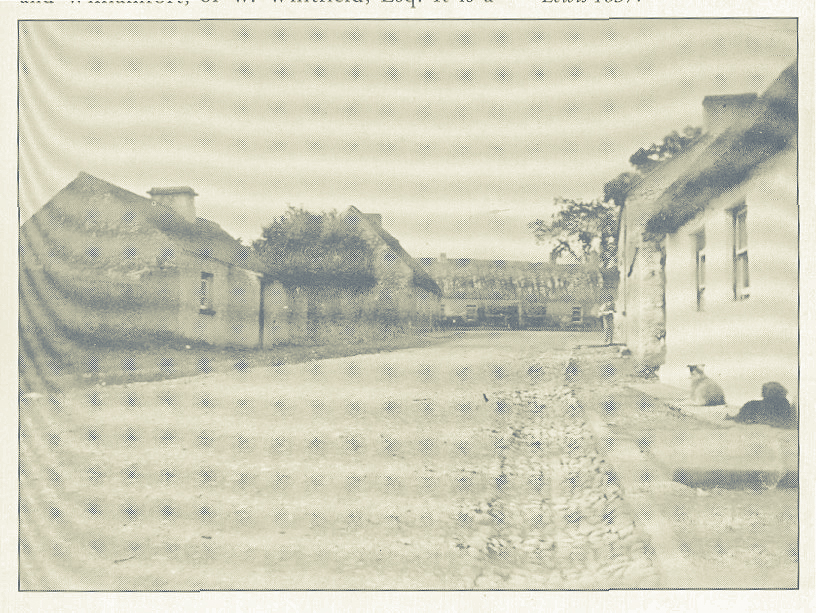
Ballyboy Village History
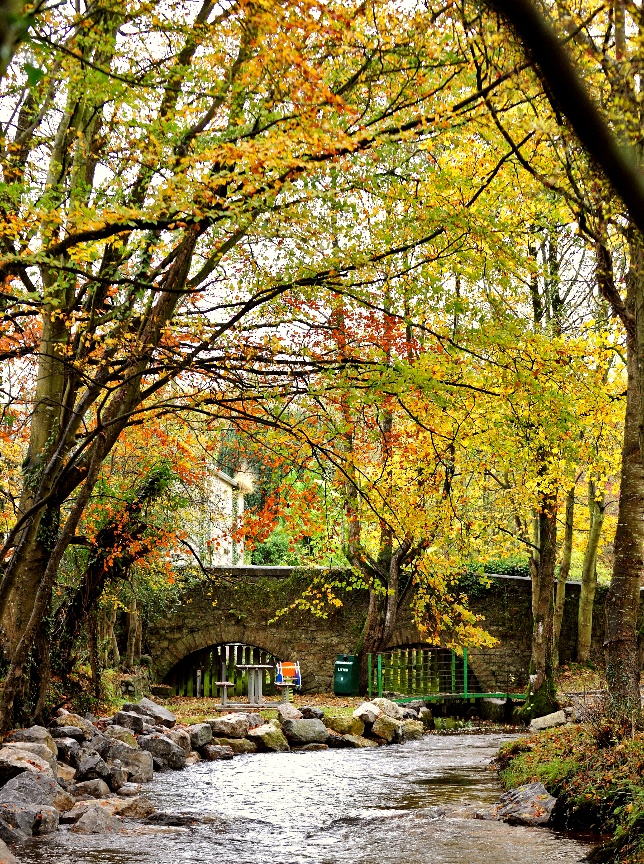
Nestled quietly between the Slieve Bloom Mountains and the Silver River in County Offaly lies the picturesque and quaint village of Ballyboy. The Gaelic name for Ballyboy was Baile Atha Buí meaning “the place of the yellow ford.” This was where the great road running from north to south crossed the river at the ford of Ballyboy.
In ancient times, a road or passway ran all the way from Daingean to Birr. Daingean was the stronghold of the O’Connors, and Birr was the stronghold of the O’Carrolls. During those times, Ballyboy was the main route for traveller’s moving from north to south. For the comfort of these traveller’s, a few houses were built on the hill above the ford, where people could rest after a long day walking or traveling on horseback. In its early years, Ballyboy was considered the capital of Offaly and a place of considerable trade and importation, as mentioned in the Annals of the Four Masters.It is located in the barony of Ballyboy and the territory of the O’Molloys of Firceall. (The word Firceall is an old Irish word meaning “Men of the Churches.”) It was also known as the Parish of Ballyboy; the present ruined church was once the Parish Church. There were 36 townlands in the Ballyboy–Kilcormac area. According to the 1821 Census, the barony of Ballyboy (which included Killoughey, Ballyboy, and Frankford) had a population of 7,205.
Over the years, the main road was referred to as the “Old Road” and the “Coach Road.” Ballyboy must have been a very welcome sight for weary traveller’s making their way from Tara to Cashel, or vice versa. The northern road linked the Slieve Bloom Mountains with the Bog of Allen and, more importantly, joined the ancient Munster Road, which connected the royal forts of Cashel and Tara.
Important Dates in Ballyboy’s History
- 500 AD – St. Brigid founded a convent at Ballyboy
- 600 AD – O’Molloy becomes ruler of Ballyboy
- 1190 – Myler FitzHenry erects a motte and bailey at Ballyboy
- 1268 – Normans establish a foothold in Ballyboy
- 1539 – Suppression of the monastery and convent
- 1539 – Marquess of Downshire holds lease of Ballyboy land
- 1601 – Hugh O’Neill passes through Ballyboy
- 1650 – O’Molloy leases 600 acres of Ballyboy land
- 1650 – Sir John Reynolds camps at Ballyboy
- 1656 – Down Survey mentions the round tower at Ballyboy
- 1688 – Money is minted at Ballyboy
- 1690 – Lord Drogheda’s horse defends Ballyboy Castle
- 1704 – Old Church is repaired
- 1712 – Captain Sterling commands troops in Ballyboy
- 1798 – Black Horse Regiment is stationed in Ballyboy
- 1815 – Present church (St. Cormac’s) is built
- 1820 – First school is built
- 1874 – Wesley Chapel is built
- 1954 – Village hall built on site of hotel where William of Orange stayed in 1690
- 1961 – New school is built
- 1997 – Commemoration for famine victims; headstone unveiled across from the pub
- 2000 – Ballyboy Comhaltas Ceoltóirí Éireann is founded
- 2000 – Millennium stone was unveiled across from the Cemetery gate
- 2016 – To commemorate the 1916 rising a Harp shaped stone was erected outside the Church
Saint Brigid in Ballyboy
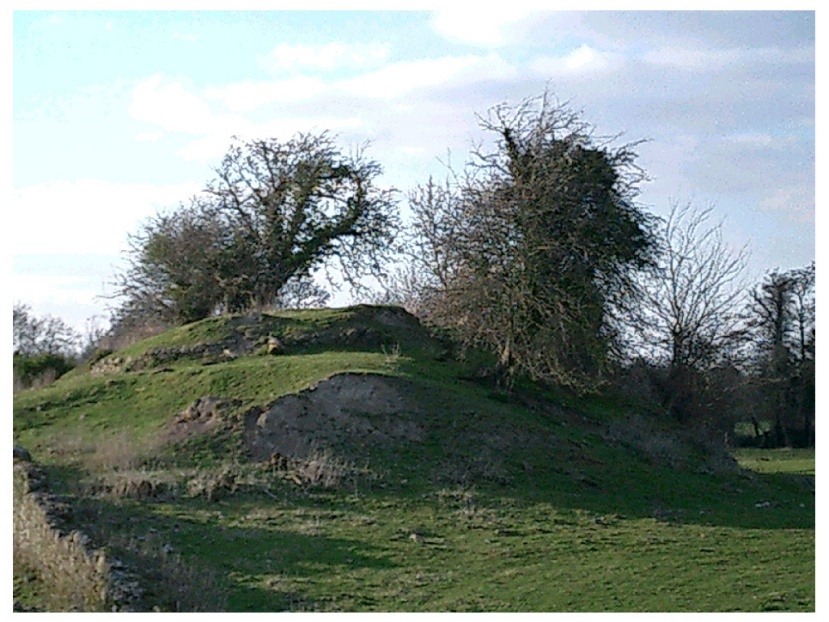
In 500 AD, history tells us that Ballyboy’s most important visitor was St. Brigid, who succeeded in founding a convent in the village. It’s quite possible this was the first convent she founded in Ireland. It is believed to have been located at the bottom of the motte on which the Normans later built their castle beside the Silver River.
The stone walls at the base of the motte are thought to be part of St. Brigid’s original convent. The convent is believed to have later expanded up the hill toward the site of St. Mary’s Church, built around the same time. Local folklore says a tunnel lined with flagstone once connected the convent and church. St. Mary’s, the original church, is thought to have stood on or near the present-day site of St. Cormac’s Church.
Approximately 20 years after St. Brigid’s visit, the territory of Firceall was invaded by the King of Meath and annexed to his kingdom. The ancestors of the O’Molloys of Meath became Firceall’s new chieftains. Over time, the barony of Ballyboy grew to 60 townlands, nearly all of which had an O’Molloy landlord—until the arrival of Cromwell in 1650. These lands now form part of the Catholic Diocese of Meath.
Ballyboy Castle
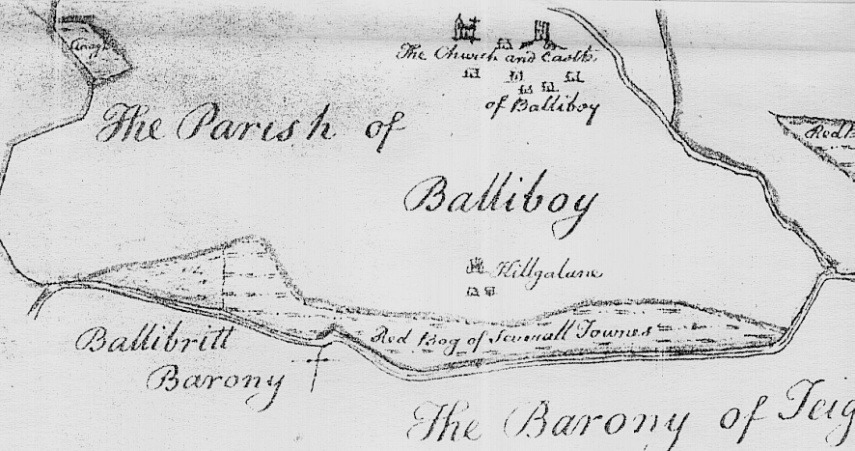
Ballyboy Castle was built by the O’Molloy’s. Its exact location is not known, though it is believed to have been near Ballyboy House, the ruins of which still stand and are owned by the Buckley family. The castle was likely built in the 12th century, and both the castle and the house are shown in the “Down Survey” conducted in the 1650s by William Petty. During the period 1260–1268, Ballyboy was known as Athboy. In 1268, Fercall O’Molloy, believed to have lived in Ballyboy Castle and the principal chieftain at the time, was killed by English invaders.
The English Invasion
In 1600, the great Earl of Tyrone, Hugh O’Neill, passed through Ballyboy with his army en route to the south. The following year, Red Hugh O’Donnell passed through on his way to Kinsale. After an earlier defeat, the O’Molloy’s had sought pardon from Queen Elizabeth. When O’Neill arrived, the O’Molloy’s joined forces with him. However, after O’Neill’s defeat in Kinsale in 1601, the O’Molloys again had to beg pardon to retain their land. In 1641, during the rebellion against Cromwell, all the O’Molloys joined the uprising. They were defeated, and William Molloy—who owned lands in Ballyboy, Luganiska, Knockhill, and Drynagh—lost 908 acres. These lands were transferred to Sir William Petty, Cromwell’s cartographer. His descendants took the name “Lansdowne.”
Cromwell’s soldiers were spotted approaching Ballyboy from the top of Knockhill. Villagers hid in underground caves—narrow openings dug into the earth, concealed with furze bushes. The soldiers found the village deserted and moved on toward Meath. Afterward, Ballyboy prospered. Its population increased, and small businesses thrived: including a mint, tanneries, merchants, blacksmiths, millers, wheelwrights, carpenters, bakers, nail-makers, a hat factory, and a distillery.
Ballyboy Church
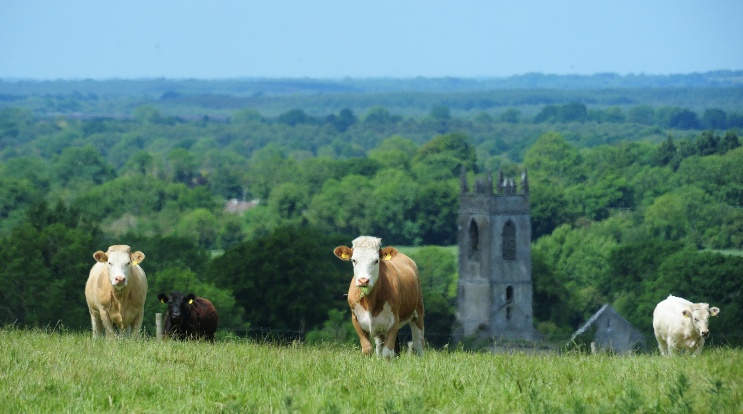
The original church, St. Mary’s, was built around 500 AD. The present-day St. Cormac’s Church was constructed in 1815 with a bank loan of £900. In 1874, it was struck by lightning during a thunderstorm, splitting the tower. Local history tells of a body being flung from a grave and a large flagstone over a vault being split in two. The church was later repaired with a grant of £279.Over the years, the church served both Protestant and Catholic communities.
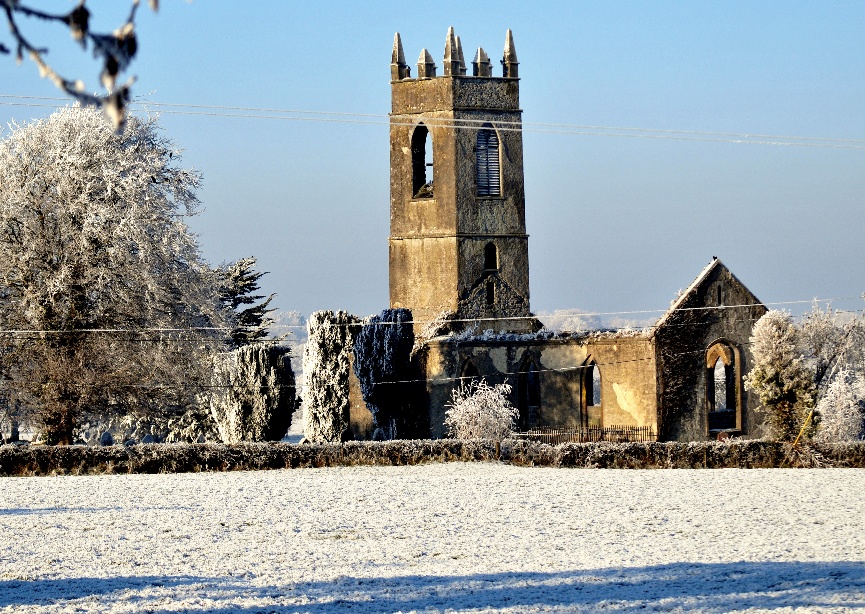
Wesley Chapel
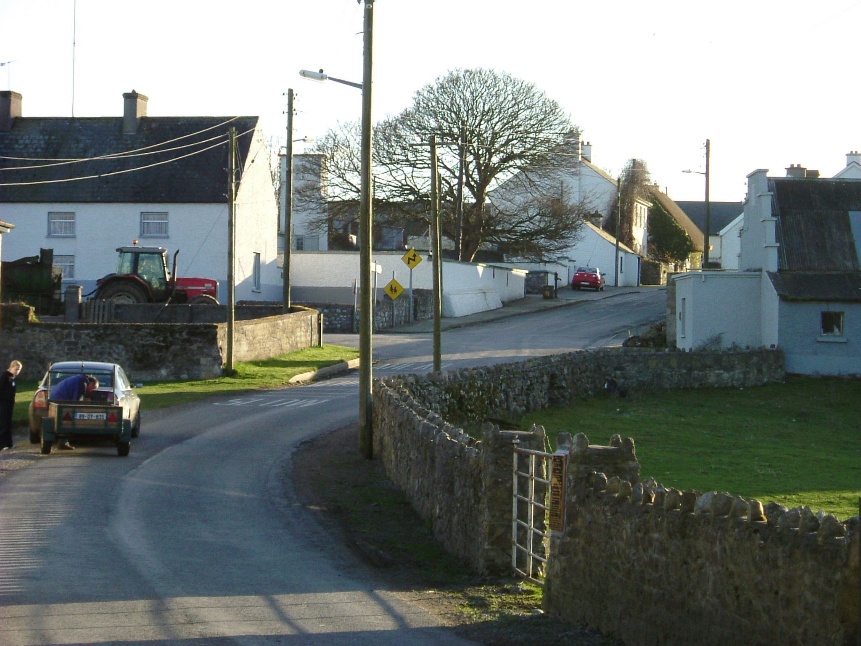
In 1874, following a disagreement with the local priest, a number of parishioners refused to attend church in Kilcormac. Instead, they built a new chapel in Ballyboy, called the Wesley Chapel. Though there was no resident minister, the people held prayer services themselves on Sunday evenings, with a visiting minister from Birr once a month.
By 1900, the chapel was no longer in regular use. It became a hall, then fell into disrepair during WWI. In 1930, the Wesley denomination sold the building to Daniel Lynch. He started a blacksmith’s forge, and his wife Elizabeth opened a grocery shop in the same building. The Bible used in the church was donated by the clergy from Birr and is now on display in “Dan and Molly’s” pub. The building is now a private home owned by Simon Buckley and family.
The Story of the Pietà
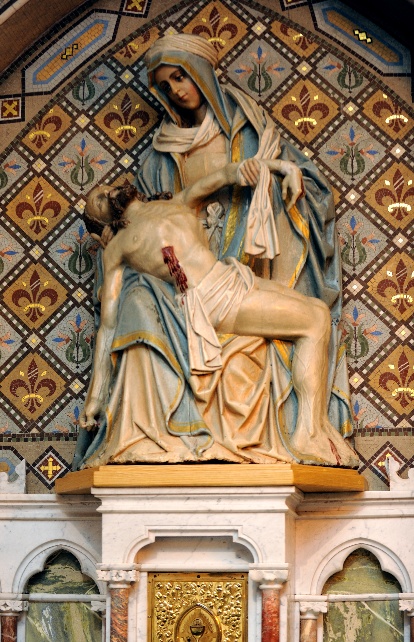
The Pietà—a statue of Mary holding Jesus after the crucifixion—was donated to Ballyboy Church by a wealthy lady in the 1600s, said to have been the wife of one of the O’Molloys. During the Penal Laws, when Catholicism was outlawed, Cromwell’s soldiers were spotted approaching from Cadamstown. Two members of the McRedmond family saw them from Knockhill and organized the removal of the statue, hiding it in bushes.Later, locals buried it in the Bog of Allen. About 60 years later, the last surviving person who knew its location led others to retrieve it. It now resides in the Church of the Blessed Virgin Mary in Kilcormac.
Dan and Molly’s Pub
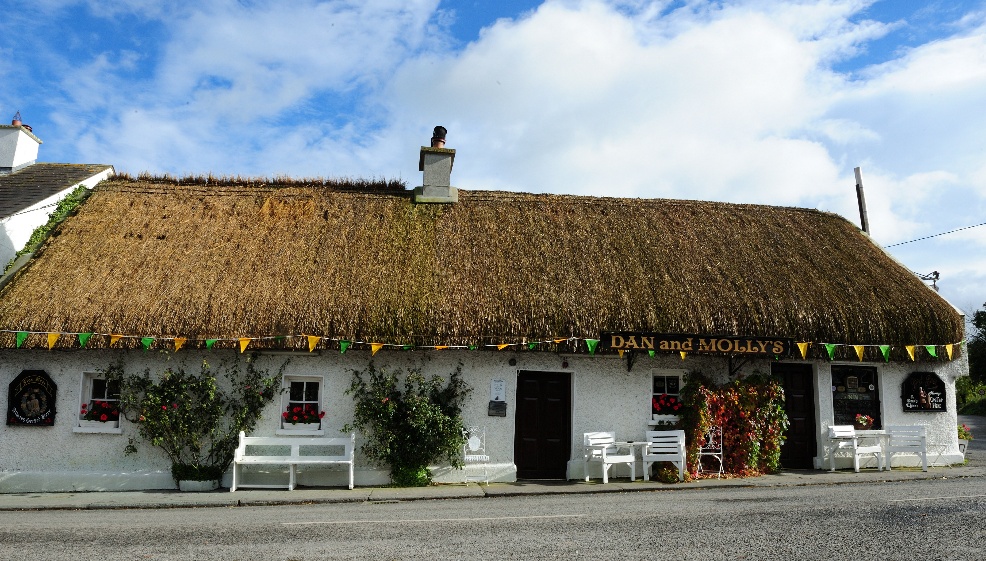
Built in 1800 by the Redmond family, this pub has passed through the hands of the Molloy, Pettit, Lynch, and Ryan families. Molly Ryan married Dan Boland, and they renamed it “Dan and Molly’s. This iconic pub is known far and wide.Today, it’s owned and operated by Molly’s daughter Catherina and her husband Fergal McDonald. The family have a keen interest in the arts and music which has passed through 4 generations_ namely Jack Ryan, his daughter Molly, Granddaughters Catriona and Stella, and now the great grandchildren Daniel, John, Séan, Anna and Katie. It is the only straw thatched pub in Offaly, and the central hub of activity in the village. Various social events and activities take place in the pub on a regular weekly basis.
DAN and Molly’s. (Thatched Pub )
Well Johnny drifts in to the Bar like a Ghost
But don’t drop you guard cause he’s cuter than most
And to all women there he would offer a toast
But he hasn’t a good reputation
If you’re wife or your in-laws they happened to stray
Or any new Girl that would enter the Fray
Just watch out for him it’s all I will say
He makes the best of a poor situation.
Chorus
So come on boys get ready, it’s that time of the week
After the all the hard slogging a drink we will seek
So up to Dan and Molly’s we’ll go for a few
If the wife doesn’t come I’ll excuse her
There’s talk of the tiger and of course GAA
Of times that have passed and the old IRA
And theres not many there without something to say
On a Saturday night in the Boozer
I see Katie McCann who has just sauntered in
And from what we are told she is without sin
If there was a contest she surely would win
She’d talk for the whole generation
For any prior knowledge that she doesn’t know
She’s never afraid just to give it a go
So out from her mouth the stories will flow
I’m sure she’s no match in this nation.
Now Aidean is poised at the end of the house
And at first impressions he’s as quiet as a mouse
But once he gets started you better look out
He’s no match when it comes to drinking
He’s drank with McAlpine and drank with them all
He’s drank with John B and even Frank Hall
Spent time with the Apostles Peter and Paul
He must be a man of distinction.
Bold Benjy arrives with the Gel in his hair
He thinks he’s still 20 and hasn’t a care
And he heads to the bar and lets out a shout
Can I have a beer please there! “Molly”
He’s been flirting with girls for 30 odd years
He’s religious courted without any fears
He has outlasted most all of his peers
And we wish him the best in the future.
Song composed by Paddy Buckley. Set to the Air of the “Limerick rake”.
The Ballyoran Céilí Band & Ballyboy Musical Heritage
The Ballyoran Céilí Band (1957–1962)
Formed in 1957, the band played locally for many years and left a lasting musical legacy.
Original Members:
- Danny Coughlan – Accordion
- Joe Daly – Saxophone
- Peadar Coughlan – Accordion
- John Brady – Flute
- Eddie Madden – Fiddle
- Bernadette Coughlan & Anne Kilroe – Singers
Later Members:
- Seán Ryan – Fiddle
- Maureen Kenny & Mary Tyrrell – Piano
The band finished in 1962 after some very successful years.
Local Dance Bands Through the Years
The Guinan Family (Derrydolney, 1970):
Catherine, Denis, Theresa, Maura, Danny, Kieran
Dominant 4 (1969):
Brendan Lee, Tom Buckley, Michael Moore, Michael Kilmartin
The Spacemen (1967):
Cormac Carroll, Tom Buckley, Frank Lynch, Michael Kilmartin, Simon Buckley
The Breakaways:
Liam Buckley, Seán Guy, Johnny Bastic
The Fusiliers:
Paddy Buckley, Simon Buckley, Kieran Guinan, Tom Buckley.
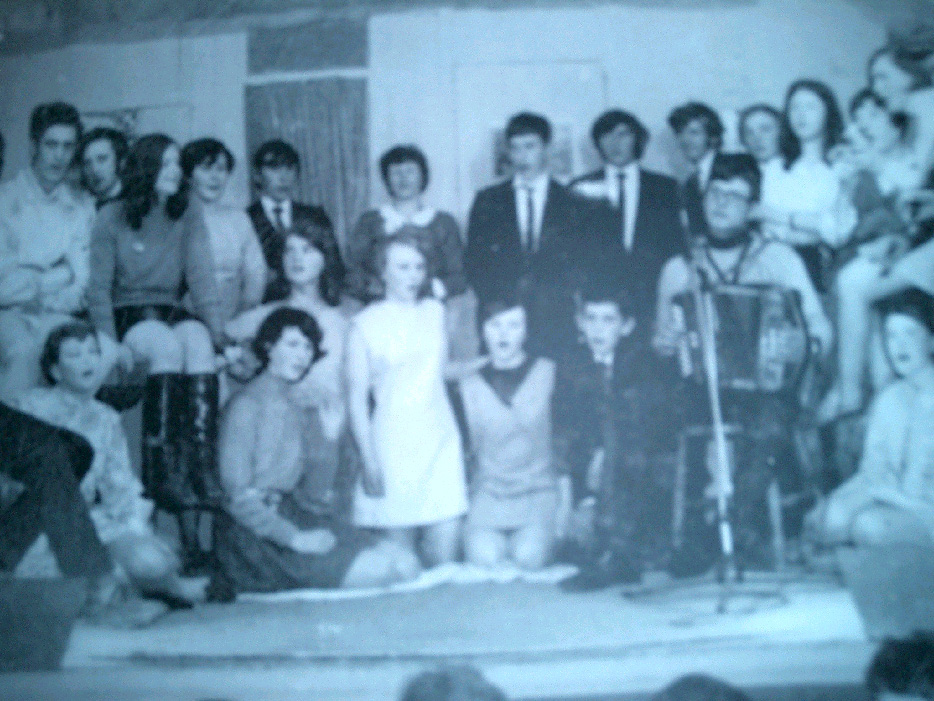
Musicians from a Past Era
- Danny Boland, Ballyboy – Piper
- Danny Feighery, Coolanarney – Piper
- Bernie Guinan, Derrinboy – Accordion & Fiddle
- Denis Flynn, Ballyoran – Fiddle
- Michael Coughlan, Ballyoran – Fiddle & Melodeon
- Jack Ryan, Ballyboy – Fiddle
- Peter Bracken, Ballyboy – Melodeon
- Denis Guinan, Derrydolney – Accordion
- Danny Rigney, Killoughey – Accordion
- Jimmy Lamb, Mountbolus – Accordion
- Paddy Leonard, Derrinboy – Melodeon
- Tom Feighery, Coolanarney – Melodeon
- Joe Sutherland, Kilcormac – Fiddle
- Jack Mannion, Killyon – Accordion & Drums
- Tommy Paye, Ballindown – Accordion
- Johnny Grimes, Knockbarron – Fiddle
- Mrs. McGovern, Ballycolin – Concertina
Ballyboy Surnames – 1901 Census
Common surnames recorded in Ballyboy at the time included:
Heffernan, Digan, Cassells, Deegan, Mitchell, Carroll,
Fletcher, Danaher, Buckley, Ward, Pettit, Atkins,McRedmond,
Kelly, Lynch, Bracken, Carpenter, Jackson, Kinahan, Kershaw.